


Vampirio: Defend & Survive
Outfit7 Neo Limited
I spent time with Vampirio: Defend & Survive as the kind of game you pick up in a spare moment, then return to when you want a little more pressure. It is an action game from Outfit7 Neo Limited, built around a simple rhythm: use the safer part of a run to prepare your fortress, then deal with increasingly tense monster attacks when darkness arrives. That day-and-night structure gives it a clear identity, but the real appeal is how quickly it turns a short session into a decision about risk, preparation, and whether one more attempt is worth it.
The game is free to download and is marked for Everyone, which makes it easy to consider for a shared phone or tablet. Still, an age label does not automatically tell me whether every player in a household will enjoy the same experience. The action is more suitable for someone who likes repeated attempts and light strategic planning than for a child looking for a completely relaxed building toy. In my experience, the best way to approach it is as a compact roguelike challenge with fortress-building on top, rather than as a traditional long-form base-management game.
How Vampirio fits into a shared household
A game that works well in short, informal turns
One reason I can imagine this game being passed around at home is that its central idea is easy to explain. One person can say, “Build during the day and see how long you last at night,” and another player understands the basic goal immediately. That makes it more approachable than an action game with a large story, a long tutorial, or a complicated set of controls that needs to be learned before anyone else can try it.
A realistic household scenario would be a shared tablet left in the living room. One player starts a run while waiting for dinner, another takes over later, and the first player returns to try a different approach. The attraction is not necessarily playing together at the same time; it is comparing choices. Did one person invest too heavily in defense? Did another take a more aggressive route? Even without turning the game into a formal competition, those conversations give the fortress a sense of ownership.
That shared-device appeal comes with an important boundary: the game should be treated as a personal run-based experience unless everyone agrees on how turns work. A player who pauses or leaves a run for somebody else may return to find that the plan has changed. For a household, I would decide in advance whether each person gets a separate attempt, whether the device is handed over only between waves, or whether one person is responsible for a full session. This small rule prevents most of the frustration that can come from a communal game.
Related News






Why the day-and-night loop is easy to understand
The strongest design choice is the contrast between preparation and survival. Daytime encourages me to think ahead, while nighttime asks whether those preparations were sensible enough. That separation makes every run feel like a test of judgment rather than a sequence of unrelated fights. I am not only reacting to monsters; I am trying to understand what kind of danger the next phase might expose.
This also gives younger or less experienced players a natural learning pattern. They can see a consequence, remember what happened, and change one decision in the next attempt. The game does not need a long explanation for that lesson to land. If the fortress is too weak, the next daytime phase becomes an opportunity to correct the mistake. If a player spends too much effort preparing and still struggles, they can try a different balance rather than assuming the whole game is unfair.
For adults sharing the same device, the loop offers a different benefit. It is easy to stop at a sensible point instead of being pulled into a long story chapter. That makes it a better fit for a quick break than many action adventures. The trade-off is that repeated runs can feel familiar if the player does not enjoy experimenting. Someone who wants constant new locations, a large narrative, or a strong social mode may find this focused structure narrow.
Gallery
What I would explain before handing over the device
I would tell a new player not to judge the game by the first few minutes alone. The interesting decisions appear when preparation has consequences, not when the controls are merely being learned. I would also explain that losing a run is part of the format. A failed defense is useful only if the player is willing to examine what went wrong and try again.
That advice matters more on a shared device because a younger player may interpret a defeat as a personal failure, while an experienced player sees it as information. A quick conversation can change the mood: ask which part of the fortress fell first, what was protected, and what could be changed before the next night. This turns the game into a small exercise in planning without pretending that it is an educational application.
Keeping progress and ownership clear
Shared use also raises a practical question: who is the current run for? If several people use one device, I would avoid making important decisions while another person is watching unless both players agree. The game’s enjoyment comes partly from making choices under pressure, and taking that control away can make the result feel less personal.
I would also keep expectations realistic about account boundaries. Nothing in the experience should be assumed to create separate household profiles simply because several people use the same phone or tablet. If distinct progress matters, the safest household habit is to decide whose session is active before starting and avoid casually switching between players. That is less convenient than a dedicated family setup, but it prevents arguments about who changed a run.
Boundaries, coordination, and everyday play
Setting up a sensible play routine
Because the game is free, it is easy to install impulsively and pass the device around. The more useful approach is to establish a small routine first. I would let each player complete an introductory attempt without advice, then compare what they noticed. After that, a household can agree on whether the game is for quick individual turns or for one person playing while others suggest strategies.
This distinction is more important than it sounds. Back-seat advice can be entertaining when the player welcomes it, but irritating when every decision is being watched. The fortress-building phase especially benefits from quiet concentration. If the player is trying to decide between immediate protection and a longer-term plan, a room full of suggestions can make the choice feel less like their own.
For a busy household, I would use the game as a short evening activity rather than promising a full group session. A parent might play one run while waiting for a child’s activity to finish, then let the child try after discussing the basic goal. A pair of siblings could alternate complete attempts instead of taking turns every few seconds. That keeps the rhythm intact and makes the outcome easier to understand.
Coordination without pretending it is a multiplayer game
The game can encourage coordination around a device, but that is different from offering direct cooperative play. I would not present it as a team experience where everyone controls the fortress together. Its value in a household comes from discussion, observation, and comparing decisions, not from assuming that multiple players are sharing one live battle.
A useful method is to give the active player a clear role and everyone else a limited role. The player controls the run; another person can remember which defensive choice worked; a third can simply watch for patterns. Then the roles change between attempts. This avoids the common problem where the most experienced person takes over and the newer player becomes a spectator.
There is also a good reason to avoid constant coaching. Roguelike action games are often enjoyable because the player discovers a workable strategy through mistakes. If somebody explains every decision before it happens, the game becomes a checklist. I prefer offering one suggestion after a defeat, not a stream of instructions during the entire run.
Purchases need a separate household conversation
The free entry point is helpful, but the game includes in-app purchases ranging from $0.49 to $99.99 per item. That is a wide enough range that I would discuss spending before letting a child use it on a shared device. The sensible boundary is not complicated: decide whether purchases are allowed, who approves them, and whether the device owner must be present before any transaction.
I would not assume that a free download means the whole household experience will remain free. Even if a player is perfectly happy with the basic game, the presence of optional spending can change the conversation when children share a phone with an adult. A clear rule is better than dealing with an unexpected purchase afterward. For family use, I would also keep the device’s normal purchase protections active and avoid handing over payment access casually.
This is one area where the game may be less comfortable than a fully paid action title with no purchase layer. A player who dislikes store prompts or feels pressure around optional spending may prefer a different game, even if the core fortress loop is appealing. The price range does not make the game automatically unsuitable, but it does make supervision part of a responsible setup.
Age rating and trust in practice
With an Everyone content rating, Vampirio is positioned for a broad audience. I still think parents should watch a first session, especially if a child is sensitive to monster attacks or gets upset by repeated failure. The rating helps with the basic suitability question, but it cannot replace knowing the individual player.
The trust issue is less about frightening content and more about how a player handles pressure, repetition, and spending. A child who enjoys trying again may find the loop motivating. Another child may become frustrated when careful preparation does not guarantee survival. I would use the first few sessions to see whether the game encourages curiosity or simply produces anger.
For older children and adults, the game’s accessible presentation may be a strength. It does not require a household to share the same level of gaming experience before someone can participate. A player familiar with action games can focus on efficiency, while a newcomer can focus on learning the day-and-night rhythm. The limitation is that experienced players may want deeper systems than this compact format provides.
Practical details before installing
The game is available as a free action title, with a minimum operating-system requirement of Android 6.0. Its current version is 1.5.10.25847, so I would check that a shared Android device is reasonably up to date before troubleshooting performance or compatibility. I would also leave enough time for a proper first session rather than handing it to a child during a rushed moment and expecting an immediate verdict.
Its release date is October 9, 2025, which places it among newer entries in the category. That makes the current version especially relevant when deciding whether the experience feels polished on a particular device. I would judge it by actual comfort on the household hardware: readable action, responsive controls, and whether the device remains pleasant to hold through a complete attempt.
Where it stands beside familiar action alternatives
Compared with a conventional arcade action game, this one asks for more planning between encounters. You are not only chasing a high score through immediate reactions; you are shaping a fortress and then living with those choices. That makes it a better match for players who like action with a layer of preparation.
Compared with a full strategy or base-building game, the experience is more immediate. I do not approach it expecting a large settlement, elaborate diplomacy, or a long-term management project. The fortress matters because it affects survival in the next dangerous phase, not because I am running a permanent civilization. Players who want a deep construction sandbox may prefer a dedicated strategy title.
Compared with a purely casual game, the repeated failure loop gives it more bite. A player who wants something they can win without thinking may find the night phases too demanding. On the other hand, someone who enjoys learning from a failed run may appreciate that the game turns a short session into a small tactical puzzle. That middle ground is its most convincing position.
Three habits that improved my runs
My first useful habit was to treat daytime as a planning window rather than a shopping spree. It is tempting to spend immediately on whatever looks helpful, but a fortress is only effective when its parts support the danger I am expecting. I found better results by pausing mentally before each purchase and asking what problem it solves. If the answer is vague, saving the choice for a more urgent need is often wiser.
Second, I stopped judging a strategy by whether it survived one night. A single successful defense can be misleading, especially if it leaves the fortress poorly prepared for the next challenge. I began looking at the condition of the whole run: did the choice protect the vulnerable area, preserve flexibility, or merely delay the same problem? That broader view is more useful than celebrating a narrow escape.
Third, I recommend changing one major decision at a time. When a run fails, replacing every choice makes it impossible to know what actually helped. Keeping most of the approach intact while changing one defensive priority creates a simple comparison. This is particularly useful when several people share the device, because each player can explain a specific experiment instead of arguing over an entirely different play style.
Who should play and who should skip it
I would recommend the game to someone who likes action that rewards preparation, short repeatable sessions, and the satisfaction of improving after a defeat. It is also a reasonable choice for a household that wants one accessible game to discuss and pass between players, provided everyone understands that the runs are not automatically separate or cooperative.
I would skip it for a player who wants a strong story, guaranteed progress every session, or a large social component. I would also hesitate to choose it for a child who becomes upset by losing or who can access purchases without adult supervision. The Everyone rating is reassuring, but the free-to-play structure and repeated survival pressure still deserve an adult’s attention on a shared device.
My household verdict
After playing it, I see Vampirio as a focused action game that earns its place through a clear preparation-versus-survival loop. It is easy to explain, quick to revisit, and flexible enough for a solo player or a group of people taking turns around one screen. The fortress gives each attempt a personal angle, while the nighttime attacks provide the pressure that makes those earlier choices matter.
Its weaknesses are equally clear. Shared progress needs household rules, optional purchases call for firm boundaries, and players who dislike repetition may run out of patience. It is not the right substitute for a deep strategy game, a story-led adventure, or a genuine cooperative title. I also would not hand it to a child and assume the Everyone label answers every practical question.
For the right home, though, it works well as a compact game that creates conversation without requiring a formal multiplayer setup. I would install it for a player who enjoys experimenting, let each household member establish their own turn-taking routine, and agree on spending before the first session. With those boundaries in place, the game’s strongest quality becomes easy to appreciate: every night is a direct response to what you decided during the day.
Its audience response is encouraging, with a 4.5 average from around 2.3 thousand ratings and more than 100 thousand installs. Those figures do not replace personal taste, but they fit my impression of a game that is approachable on entry while still asking the player to think. My final recommendation is positive for families and friends sharing a device, as long as they want a repeatable action challenge rather than a passive or completely consequence-free pastime.
FAQs for Vampirio: Defend & Survive
What is Vampirio: Defend & Survive?
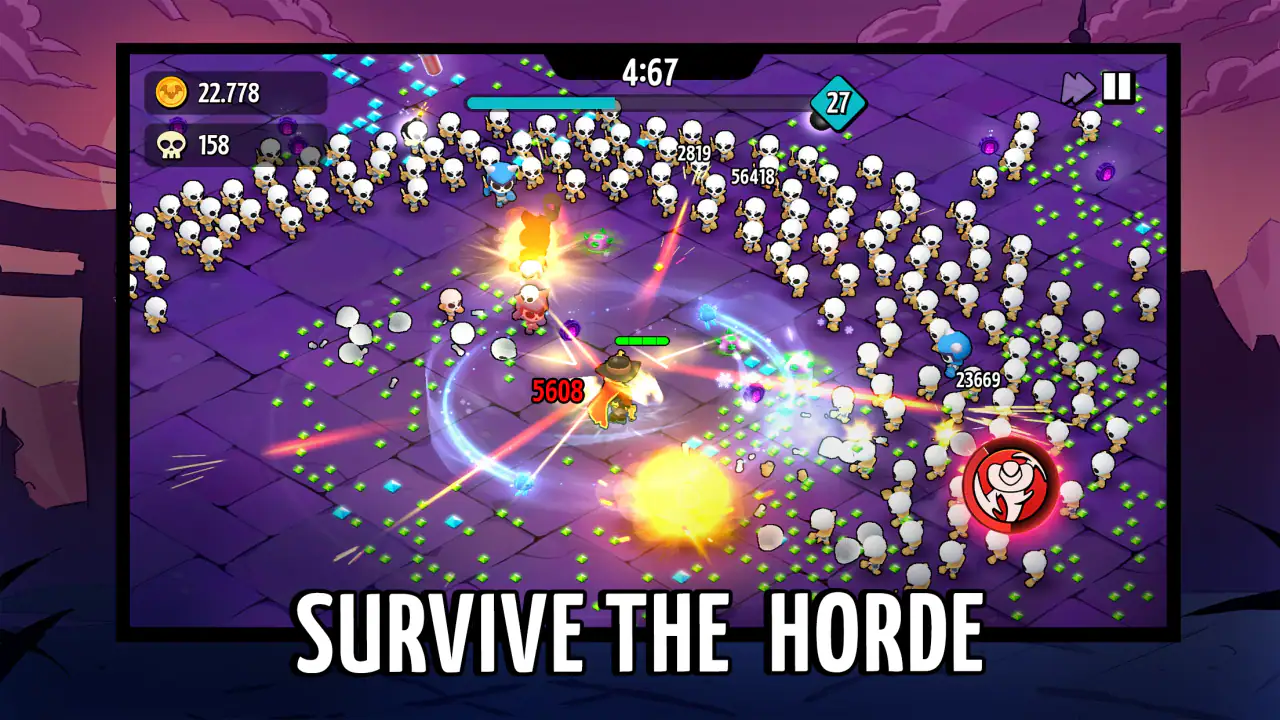
Vampirio: Defend & Survive is an action survival game centered on battling continuous waves of enemies while trying to stay alive as long as possible. You control a powerful character, collect experience and useful items, unlock new abilities, and improve your build during each run. The gameplay is designed to be quick to understand, but progressively more demanding as enemy numbers and strength increase.
How does the gameplay work in Vampirio: Defend & Survive?
The game follows a wave-based survival format. Your character attacks automatically or with limited manual input, allowing you to concentrate on movement, positioning, enemy avoidance, and choosing upgrades. Defeated enemies can provide experience or rewards, while level-ups let you select abilities that shape your strategy. Every run can feel different depending on the weapons, bonuses, and improvements you choose.
Can Vampirio: Defend & Survive be played offline?
Many parts of Vampirio: Defend & Survive may be playable without a constant internet connection, particularly the main survival runs. However, online access can still be required for advertisements, cloud-related features, events, updates, purchases, or other connected services. If offline play is important to you, it is best to test the game after installation and check whether the latest version has specific connection requirements.
Is Vampirio: Defend & Survive free to download and play?
Vampirio: Defend & Survive is generally offered as a free-to-download game, so you can install it and try the core gameplay without paying an upfront purchase price. Like many mobile action games, it may include optional advertisements, rewarded videos, or in-app purchases for additional resources and convenience. These purchases are not necessarily required, but they can affect progression speed.
What devices are compatible with Vampirio: Defend & Survive?
Compatibility depends on the operating system, device model, available storage, and the minimum requirements listed on the official Google Play Store or Apple App Store page. The game should run best on relatively modern Android and iOS devices with updated software and sufficient free space. Older phones may experience longer loading times, reduced performance, or occasional frame-rate drops during crowded battles.
Pros
- Quick sessions suit short breaks and casual play.
- Simple controls make the game easy to pick up.
- Survival waves create a satisfying sense of progression.
- Character upgrades encourage experimentation with different builds.
- Dark visuals and effects fit the vampire-themed atmosphere.
Cons
- Later waves can feel repetitive without enough enemy variety.
- Some upgrades may take considerable time to unlock.
- The screen can become crowded during intense battles.
- Difficulty spikes may frustrate players seeking a relaxed experience.
- Progression may feel limited once the main upgrades are completed.


